5.0

(912) 225-4938 Serving Georgia & South Carolina
Request Call Back
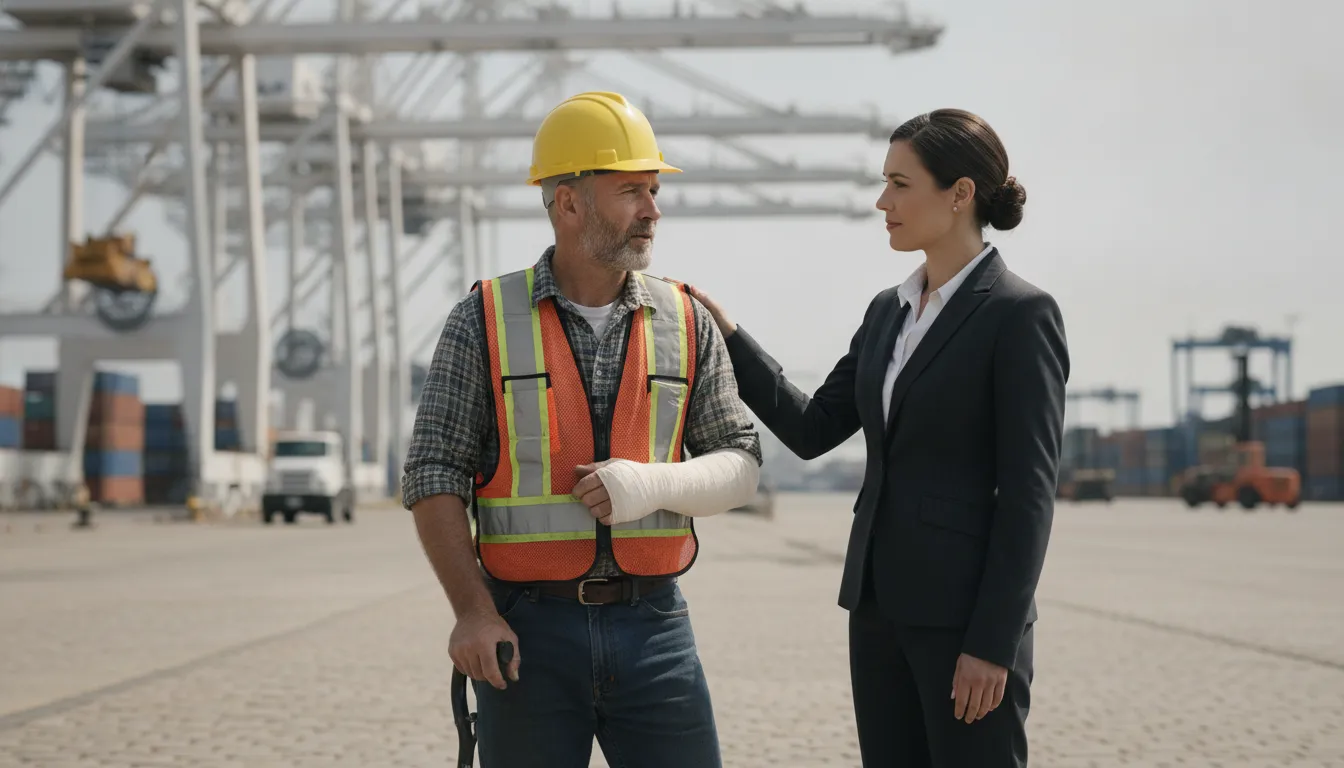
An injury at a port, dock, terminal, or vessel-loading area can raise difficult questions before you know which rules apply. The location of the incident, the work you were performing, your employment role, and the medical records documenting the injury may all matter. Start by getting appropriate medical care, reporting what happened, and preserving photos, messages, schedules, and witness information.
Request a free case evaluation. Contact The Cornwell Firm if you need help understanding what to document or do next.
People searching for a longshoreman injury lawyer in Savannah, GA often begin with the Longshore and Harbor Workers' Compensation Act, or LHWCA. The federal law may provide compensation and medical care for qualifying injuries connected to covered maritime work and locations, but eligibility depends on specific facts. The U.S. Department of Labor explains that its materials are informational, so a careful review should not assume every port worker follows the same process.
Understanding what makes a longshore or harbor-worker claim different is the first step toward organizing your records and asking focused questions about your situation.
A longshoreman injury claim generally involves a work-related injury that may fall under the federal Longshore and Harbor Workers' Compensation Act (LHWCA). The LHWCA provides compensation, medical care, and vocational rehabilitation for qualifying work injuries in covered maritime locations. It may also provide survivor benefits when a work injury causes or contributes to an employee's death. The U.S. Department of Labor explains the basic framework, but its guidance is not a decision about any individual claim.
Traditional maritime occupations identified by the Department of Labor include longshore workers, ship repairers, shipbuilders, ship breakers, and harbor construction workers. The law can also reach some employees who do not have a traditional maritime job when both their work and injury occur on navigable water. That means a person's job title alone may not answer whether the LHWCA applies.
Location is another important part of the analysis. Covered areas can include navigable waters and adjoining piers, docks, terminals, and wharves used for loading, unloading, repairing, or building a vessel. A qualifying injury may therefore happen on the water or in a waterfront work area connected to vessel operations. The specific worksite and what the employee was doing there still matter.
In Savannah, a worker's eligibility can depend on several facts, including the person's duties, employer, work location, and how the injury happened. Not every injury at or near a port follows the same rules, and this overview cannot determine whether a particular claim qualifies or what benefits may be available. A careful review should begin with the incident details, employment role, and medical records. For the governing federal overview, see the Department of Labor's LHWCA FAQ.
Work around Savannah port facilities can involve moving cargo, operating equipment, working near vessels, and navigating wet, crowded, or changing surfaces. The hazards are not limited to one type of accident. A worker may be hurt during a single event, or develop symptoms after repeated physical demands.
Falls can happen from docks, platforms, ladders, gangways, or other elevated areas. A slip or trip may cause a sprain, torn ligament, concussion, broken bone, or back injury. A fall near the water can create additional danger, especially when a worker is isolated or rescue is delayed.
Equipment incidents may involve forklifts, cranes, trucks, winches, conveyors, or other machinery. Cargo that shifts, drops, swings, or rolls can cause crushing injuries, head trauma, fractures, loss of a limb, or other serious harm. Problems at the interface between a vessel, dock, ramp, or loading area can also expose workers to sudden movement and pinch points.
Port work may expose workers to chemicals, fuel, dust, or toxic fumes. Depending on the substance and the length of exposure, a worker may experience burns, breathing problems, eye injuries, or other medical effects. Protective equipment, ventilation, and the circumstances of the exposure can matter when the injury is investigated.
Repetitive lifting, gripping, climbing, and awkward movements can contribute to strains and other overuse conditions. Symptoms may build gradually rather than appear at a single moment. A worker should not assume that a less dramatic onset means the condition is unimportant.
After an injury, preserve available information when it is safe to do so. Photos of the area, equipment, cargo, and visible conditions can help. Identifying witnesses and preserving incident records are also useful investigation steps. The relevant facts may include what task was underway, where it occurred, who controlled the equipment or area, and when symptoms began.
A careful review starts with the details that connect your job, the waterfront setting, and the injury. Bring a description of your role, the employer or staffing company involved, the vessel or facility, and the exact location where the incident occurred. Work schedules, time records, job assignments, and training materials may help clarify what you were doing and who controlled the work.
Incident reports, accident logs, photographs, video, and written notices can preserve information that becomes harder to obtain later. Identify coworkers, supervisors, contractors, vessel personnel, and anyone else who saw the event or its immediate aftermath. The review may also consider equipment inspection records, maintenance history, safety procedures, and communications about hazards or prior problems. Do not alter or discard equipment, clothing, or other physical evidence without first asking how it should be preserved.
Medical records are another important part of the picture. Keep records of emergency treatment, follow-up care, diagnoses, restrictions, prescriptions, and the way symptoms affect ordinary activities. Wage records, missed shifts, reduced hours, and other documentation of lost income may help show the practical impact of the injury. Keep copies of messages with an employer, insurer, claims administrator, or medical provider, including requests for statements or recorded interviews.
Responsibility may require looking beyond a single employer. Depending on the facts, a review can ask whether a vessel owner, contractor, equipment manufacturer, or another third party had a role in creating or failing to correct a dangerous condition. This does not decide whether a claim exists, and longshore cases should not be treated as ordinary construction claims. For background on how multiple responsible parties may be investigated, see this discussion of third-party claims after a work injury. If a claim is disputed, the injury is serious, or an insurer makes a low offer, a work-injury legal review may help identify what evidence and questions deserve prompt attention.
Workplace injuries near the water do not all follow the same legal path. A careful review looks at the worker's actual duties, where the injury happened, the employer's role, any connection to a vessel, and the specific circumstances of the incident. Those details can matter when distinguishing a longshore or harbor-worker question from a seaman or Jones Act question, or from another workplace claim.
The U.S. Department of Labor identifies traditional maritime occupations such as longshore workers, ship repairers, shipbuilders, ship breakers, and harbor construction workers. Its guidance also says that some non-maritime employees may be covered when they perform their work on navigable water and are injured there. These descriptions provide an initial framework, not a final benefits determination.
Questions that can shape the legal category for a workplace injury| Potential category | Questions to examine | Why the distinction matters |
|---|---|---|
| Longshore or harbor-worker claim | Did the worker perform qualifying maritime or harbor duties? Did the injury occur on navigable water or an adjoining pier, dock, terminal, or wharf used for vessel work? | The work and location may raise questions under the Longshore and Harbor Workers' Compensation Act. The worker's precise role and injury setting still require case-specific review. |
| Seaman or Jones Act question | What was the worker's connection to a vessel, and what duties were performed aboard or in service of it? Was the worker's role materially different from waterfront cargo, repair, or terminal work? | A vessel connection and job duties can lead to a different legal analysis. A port injury alone does not establish seaman status or a Jones Act claim. |
| Other workplace claim | Who employed the worker, where did the incident occur, what work was being performed, and were other companies, contractors, or site conditions involved? | The facts may point toward another workplace framework or possible third-party issues. The label should follow the evidence, not replace it. |
The DOL's longshore FAQ is an informational tool and cautions that it is not a final authority. It should not be treated as a definitive ruling on an individual claim. Preserving job records, incident details, medical information, and witness names can help a lawyer evaluate the facts without assuming the outcome in advance. Read the DOL longshore FAQ for general background, then seek case-specific legal guidance about an injury in Savannah.
Prompt legal review can be useful after a port or harbor injury, especially when the facts are changing quickly. Seek a review if your injury is serious, you cannot return to work, medical treatment is being delayed, or an employer or insurer disputes what happened. A review may also help when more than one company, contractor, vessel, equipment provider, or property owner was involved.
Longshore and harbor-worker issues can depend on your job duties, where the injury occurred, and how your work relates to vessel operations. A worker on a dock or terminal may face different legal questions from a seaman or another employee injured at a workplace. The Department of Labor explains that its LHWCA FAQ is informational, not a final authority, so general online guidance should not replace a case-specific assessment.
Early review also gives you a chance to preserve useful information. Save medical records, work schedules, incident reports, photographs, messages, and witness names. Ask that relevant video, equipment, and other physical evidence be preserved when appropriate. The Cornwell Firm describes initial evaluations as a way to gather incident details, injuries, involved parties, and next steps. Its investigation guidance also identifies evidence preservation, scene documentation, and witness identification as important steps.
Do not assume that a general deadline applies to every longshore-related matter. Federal claim procedures can contain specific timing rules. For example, Department of Labor guidance discusses Form LS-203 and a one-year period under stated permanent-disability or impairment conditions. The deadline depends on the circumstances, so review Georgia personal injury filing deadlines and obtain advice before relying on any general summary.
The Cornwell Firm is locally and family-owned, established in 2017, with its primary office in Savannah. The firm offers free case evaluations, 24/7 access, English and Spanish support, and hospital or home visits when travel is difficult. You can learn about the firm and its attorneys or review answers to common injury-claim questions before reaching out.
Request a free case evaluation. Contact The Cornwell Firm to discuss what happened and what to document next.
Longshore work generally involves maritime jobs such as loading and unloading vessels, ship repair, shipbuilding, ship breaking, or certain harbor construction work. Coverage can depend on both your job duties and where the injury occurred, including navigable water or adjoining areas such as docks, terminals, piers, and wharves. The U.S. Department of Labor explains these boundaries in its LHWCA FAQ, but the agency cautions that the FAQ is informational rather than a final legal authority.
Seek appropriate medical care, report the incident through the required workplace process, and keep copies of reports, medical records, bills, work restrictions, and communications with your employer or insurer. Write down what happened while the details are fresh, including the location, equipment involved, witnesses, and any safety concerns. Photographs and preserved physical evidence may also help a lawyer evaluate what occurred.
No. The applicable rules may depend on your role, employer, worksite, injury location, and whether another company or person contributed to the incident. A longshore or harbor-worker claim is not automatically the same as a seaman claim, a Jones Act matter, or an ordinary workplace claim. A careful review is needed before anyone tells you which benefits or legal options apply.
Consider seeking review promptly if your claim is disputed, your injury is serious, medical care or wage payments are delayed, an insurer makes an offer, or a third party may be responsible. Federal guidance also describes specific filing advice for some permanent disability or impairment claims, including Form LS-203 within one year under stated conditions. Do not assume a deadline does not apply. A free case evaluation can help organize the facts and identify possible next steps without promising a particular result.
Request a free case evaluation. Contact The Cornwell Firm to discuss what happened, what your work involved, and what records may help support a prompt, case-specific review. The details of a port or harbor injury can affect which legal rules apply, so an early conversation may help clarify practical next steps without promising a particular result.